As a drum cutter supplier, I’ve spent the last 12 years sitting across from heavy equipment operators, mining project managers, and construction site foremen who all ask the same question: “How do I pick the right drum cutter for my job?” I’ve seen first-hand what happens when someone chooses a cutter based only on price—unexpected downtime, damaged carrier equipment, and jobs that take twice as long as they should. I’ve also seen how the right drum cutter turns a tough project into something that finishes on time and under budget. That’s why I’m breaking down the key factors you need to consider, no sales pitch included, just the lessons I’ve learned from working side-by-side with folks in the field. Drum Cutter
First, let’s talk about the core job your drum cutter will actually do. It’s easy to think “drum cutters cut hard materials” but not all cutting is the same. If you’re working in a quarry, you’re probably cutting through granite or basalt—rock that’s so hard it can chip a steel drill bit. If you’re doing road resurfacing, you’re likely dealing with asphalt that’s been pressed for years, maybe mixed with concrete patches. If you’re excavating for a foundation, you might be mixing soft soil with rock, tree stumps, and even old debris like concrete chunks or rebar.
I once had a customer who came to me three months after buying a cheap drum cutter online. He’d been hired to clear a 2-acre site for a new retail center, and his cutter was overheating so bad it would shut down every 20 minutes. When we pulled the cutter off his 12-ton excavator, I looked at the teeth: they were cheap carbide tips that broke off in less than 8 hours, and the drum body had small gaps that let dirt and rock pack inside, adding extra weight and straining the motor. The other issue? He’d tried to use a rock cutter on soft topsoil, which meant the drum was spinning too fast, bouncing on the ground instead of grinding smoothly. That’s a critical mistake—matching the drum’s design to your ground conditions isn’t a minor detail; it’s the difference between finishing the job and getting stuck.
Next up: matching the cutter to your carrier machine. This is the second-biggest mistake I see people make. A drum cutter only works as well as the excavator, skid-steer, or loader it’s mounted on. The two key specs here are operating weight and hydraulic flow. Let’s break that down. For weight: if your excavator is 10 tons, a drum cutter built for a 15-ton machine is going to be too heavy—it will push down harder than the carrier can handle, straining the boom and arm, and even tipping the machine on uneven ground. I had a farmer last spring tell me he mounted a 2,000-pound drum cutter on his 8-ton compact excavator to clear fence lines of tree stumps. By the end of the first week, his excavator’s arm had a hairline crack that cost $4,000 to fix. A properly matched cutter for that size machine would have been around 1,200 pounds—light enough to maneuver, but heavy enough to apply consistent pressure without damaging the carrier.
Then there’s hydraulic flow, which is the amount of fluid your machine’s pump pushes through the cutter’s motor every minute. Drum cutters need a precise flow range to run at their optimal RPM (rotations per minute). If your machine’s flow is too low, the cutter will spin too slow, clogging with material or burning out the motor. If it’s too high, you’ll waste energy, and the extra speed will make the teeth wear out much faster. Let’s use an example: our standard rock drum cutter requires 30 to 40 gallons per minute (GPM). If your excavator puts out 45 GPM, we can add a flow regulator kit that brings it down to the right range—no extra cost, and it keeps your cutter running smoothly. But I’ve had customers skip that, figuring “more flow = better,” and within a month, their motor’s seals were shot because of the extra pressure. Never skip checking your machine’s hydraulic specs; write them down before you talk to any supplier, because they’ll need that to recommend the right model.
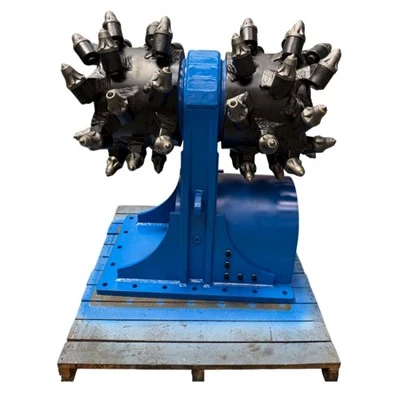
Teeth and tooth design might seem like a small part, but they’re the workhorses of the drum. Think of the cutter’s drum as a wheel, and the teeth are the sharp points that do the cutting. Not all teeth are made the same. There are two main types: conical teeth and flat (or chisel) teeth. Conical teeth are pointed, with a hard carbide tip on the end. They’re great for hard rock, concrete, or asphalt—they punch through the material without getting stuck. Flat teeth are wider, shaped like a chisel, and work better for soft soil, sod, or light excavation because they spread the force out, so they don’t dig too deep too fast.
Carbide grade is another big one. Most cheap cutters use generic carbide that breaks easily when it hits a rock. Our cutters use a grade of carbide that’s harder and more heat-resistant, which means the teeth last 2 to 3 times longer than standard ones. I have a customer in Western Australia who mines granite for kitchen countertops—his team goes through 1,200 generic teeth a month, but with our carbide, they only need 400. That saves him thousands of dollars in replacement parts and downtime. Also, look for cutters that have teeth you can replace individually, not whole segments. If one tooth breaks, you just swap that one out, not the entire row—another big cost saver.
Maintenance is a factor most people don’t think about until their cutter is broken and they’re waiting for repairs. A drum cutter has moving parts: the motor, the gears, the drum bearings. You want a cutter that’s designed to be serviced easily, not one that requires taking it to a shop every time you need to change a seal. For example, our cutters have access panels on the motor and gearbox, so you can check the oil, replace filters, and swap out teeth on-site, with basic tools. Cheap cutters often have sealed gearboxes that you can’t open, so once the oil goes bad, you have to send the whole unit away, which can take weeks. Also, ask about warranty. A reputable supplier will offer at least a 12-month warranty on parts and labor, not just 90 days. If a supplier won’t stand behind their cutter, that’s a red flag. I’ve had customers come to me after buying a cutter with a 90-day warranty that broke at 100 days—they were out $15,000 and stuck without a machine for two weeks. We always offer a 18-month warranty on our cutters, because we know they’re built to last.
Safety and operator comfort might not sound like technical factors, but they’re critical for getting the job done right. Drum cutters create a lot of vibration, dust, and noise. If the vibration is too high, it will tire out the operator faster, leading to mistakes. Look for cutters that have vibration-dampening mounts between the drum and the carrier’s arm. That reduces the shake, so the operator can work longer without feeling fatigued. Also, dust is a big issue—especially if you’re cutting concrete or rock, which creates silica dust that’s dangerous to breathe. Some cutters come with water lines to suppress dust, or you can add a dust shroud that covers the cutting area. A good supplier will ask you about your work environment, and if silica dust is a concern, they’ll recommend the right shroud or water kit for your cutter.
Finally, think about versatility. Do you only need the cutter for one job, or will you use it for multiple projects? Some drum cutters are specialized—built only for rock, only for asphalt—while others are multi-purpose, meaning you can swap out the drum (or adjust the tooth spacing) to handle different materials. For example, if you’re a contractor who does both road resurfacing and small excavation jobs, a multi-purpose cutter will save you money instead of buying two separate units. I have a customer who runs a small construction company in Ohio, and he uses our multi-purpose cutter for 80% of his jobs: paving driveways, clearing lots, and even removing old concrete patios. He told me he saved $20,000 last year by not needing to buy a second cutter for excavation.
I know this can feel overwhelming—there are a lot of numbers and specs to keep track of. The best way to avoid making a mistake is to talk to someone who’s actually worked with drum cutters for years, not a sales rep who’s just trying to close a deal. When you reach out, bring those notes you took: the weight of your carrier, its hydraulic flow, and the types of materials you’ll be cutting most often. We don’t push the most expensive cutter; we recommend the one that fits your job, your machine, and your budget.
If you’re in the market for a drum cutter and want to make sure you’re getting the right one, don’t guess—reach out to our team to discuss your project needs. We can walk you through the specs, show you case studies of similar jobs, and even connect you with other customers who have used our cutters for the same work. At the end of the day, picking a drum cutter is an investment—one that will either make your jobs easier, faster, and cheaper, or turn into a money pit of repairs and delays. Take the time to get it right, and you’ll be glad you did.
OGM Hydraulic Motor References:
- Association of Equipment Manufacturers. “Hydraulic Attachment Compatibility Guide for Heavy Construction Equipment.” 2022.
- National Institute for Occupational Safety and Health. “Silica Dust Control in Construction and Mining.” 2021.
- Cutting Tools Association. “Carbide Grade Performance in Rock and Asphalt Cutting Applications.” 2023.
- Construction Owners Association of America. “Cost of Downtime in Heavy Equipment Operations.” 2022.
Ningbo Oushijie Hydraulic Transmission Co., Ltd.
Ningbo Oushijie Hydraulic Transmission Co., Ltd. is one of the most professional drum cutter manufacturers and suppliers in China, also supports customized service. With abundant experience, we warmly welcome you to wholesale durable drum cutter at competitive price from our factory.
Address: Changshi Sanxing Industrial Zone, Jiulong Lake Town, Zhenhai District, Ningbo,Zhejiang, China
E-mail: yong@nbosj.com
WebSite: https://www.nbosj.com/
